Search This Blog

Sunday, August 27, 2006

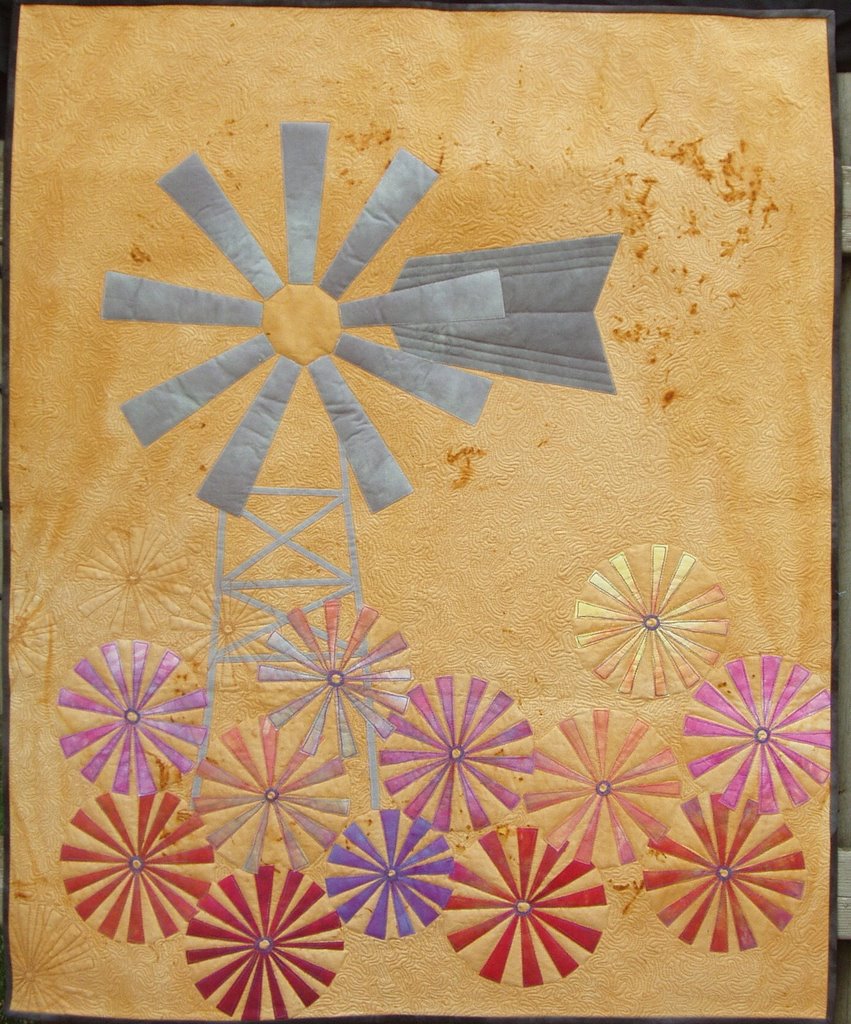
Prairie Windflowers


Bragging time! My quilt, Prairie Windflowers won a blue ribbon at the Nebraska State Fair and received the Pride of Nebraska award. The quilt is 33" X 41".

About my quilt:
I do a lot of long-distance driving across Nebraska and the other Plains states. Along with the hawks that sit on both natural and man-made hunting perches, I see windmills. The non-working windmills are harder to spot, with their missing blades and the overgrowth of vines. The working windmills make me think of a single flower, growing high above the other plants, blades turning or not, dependent on the wind “sweeping down the plain”. These are my “windflowers”.

While windmills are typically solitary figures on the landscape I’m passing at 60 MPH, there are also windmills near my house in Omaha. I am intrigued by this juxtaposition of urban and rural within the largest city in Nebraska.

One windmill is alongside the trail I walk almost every day. The trail winds along the outer edge of an urban neighborhood less than ten years old. I photograph another windmill in a park while my kids play just a few feet away on bright plastic modern playground equipment. These and other urban windmills remind us “city slickers” that Nebraska is more a land of wide-open space than suburbia.

This quilt combines a solitary rural Nebraska windmill with a splash of urban Omaha flowerbed. The background fabric was created using a can of rusty nails taken from an old barn on a farm handed down through at least three generations of Nebraskans. (A farm with a non-working windmill.) The windmill is some distance from the viewer, as are most that we see. The flowers, on the other hand, are seen at close range, perfect for viewing the subtle variations in color and shape.

Look for both windmills and flowers on your next drive!

Sunday, August 20, 2006

Kool Aid, Kool Aid!

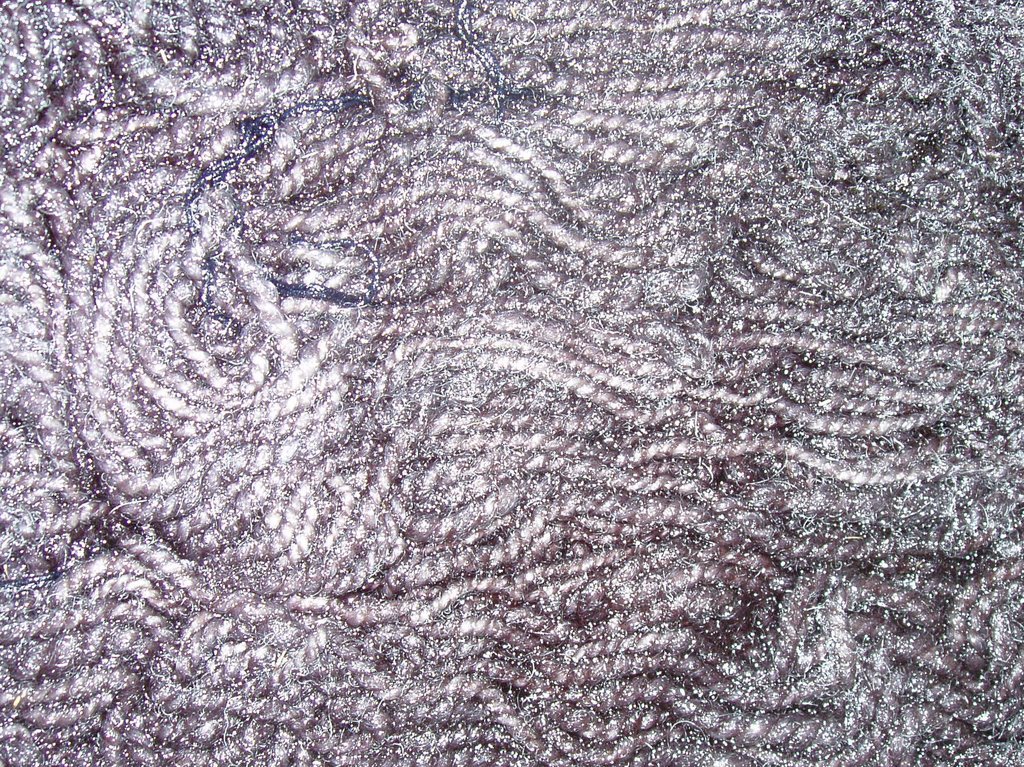
While visiting my parents, my Mom and I decided to Kool Aid dye a skein of handspun yarn (100% wool). Our yarn is heavy with lanolin. I wonder how much that will affect the color? Mom was sure she had a bunch of Kool Aid packets in the house, but we couldn't find them. When facing the decision to buy .20 Kool Aid or .10 WalMart brand, I decided an experiment to compare them was in order. I bought six packets of each, Grape flavor.


We divided the skein roughly in half. Each half was put into a glass baking pan, covered with warm water and left to soak for 45 minutes. This was an arbitrary length of time - having the wool saturated is the goal. After the excess water was gently squeezed out, the yarn was dyed using 6 packets of "dye", two glugs of white vinegar and enough water to cover.

After each dish went through a "microwave for 2 minutes, wait, microwave for 2 minutes" cycle, the WalMart brand dye had mostly absorbed into the yarn. The water in the yarn with the Kool Aid dye was still very dark. It was almost 10 pm, so we left the yarn/water to cool overnight.

The next morning, I squeezed out the excess water. I had to rinse the yarn quite a bit, which I hadn't expected. (After doing additional Kool Aid dyeing, I realize I should repeat microwave/cool cycles until the dye is absorbed into the yarn. With the heavy lanolin, that would never have happened.) I hung the skeins of yarn off the side of the deck to dry.

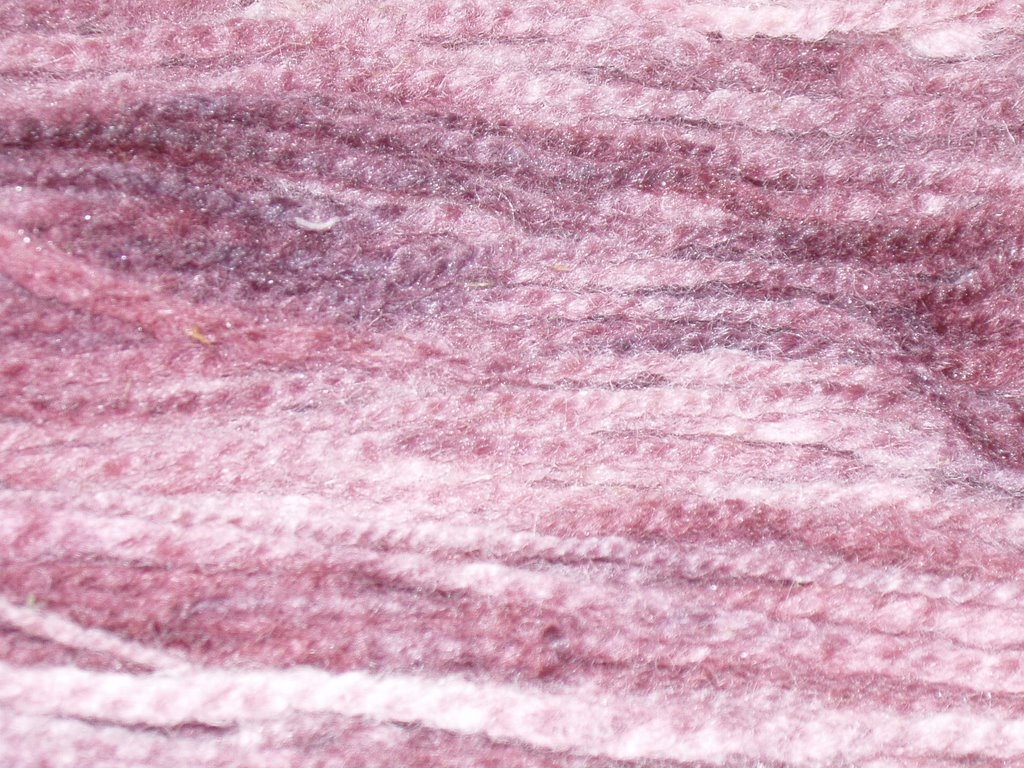
This picture shows the yarn after dyeing with a skein of the original color. The color was much weaker than I expected, which I attributed to the lanolin. There was no noticeable difference in color when I compared the Kool Aid dyed yarn to the WalMart brand dyed yarn (no picture)

When I got home, I scoured the dyed yarn. I redyed one of the skeins using two packets of Grape flavor Kool Aid. (Mom found her Kool Aid stash & sent it home with me.) I did the heat/wait cycle until the water was clear - really a light blue rather than clear. No rinsing was necessary. This picture shows (L-R) original yarn, heavy lanolin content dyed yarn, and scoured, re-dyed yarn.

No grapes were hurt during these dye sessions.

Friday, August 18, 2006

Cincinnati, Pigs, and Ice Cream

Last weekend, I was in Cincinnati, Ohio for the Zonta Quilts For Change show. I won't bore you with details about the low attendance. Instead, I'll bore you with details of the evening I spent with other vendors. I had met Roni (Sunny Bunny Designs) on-line on QuiltArt and we planned to meet in person at this show. We met during setup and made plans to go out to dinner the next night. I invited the vendors from the booth next to mine (Yoder's) and we took two vehicles to Hyde Park Square.

I rode with Roni, who never uses her turn signal and knows the back way to get around rush hour traffic! We ate at an Italian place called Indigo. I had a veggie eggplant lasagne that was wonderful! We wandered around after eating to see and be seen. We would have blended right in, except that we didn't have a dog with us, and we were talking and laughing quite loudly. I didn't see anyone else wearing Crocs either. Maybe we weren't blending as well as we thought!

We window-shopped at the boutiques around the square. We went into one shop, but after seeing the price on their $245 jeans, I didn't bother asking about the multi-stranded black pearl necklace or the green leather bag. I wanted them both. Pout.


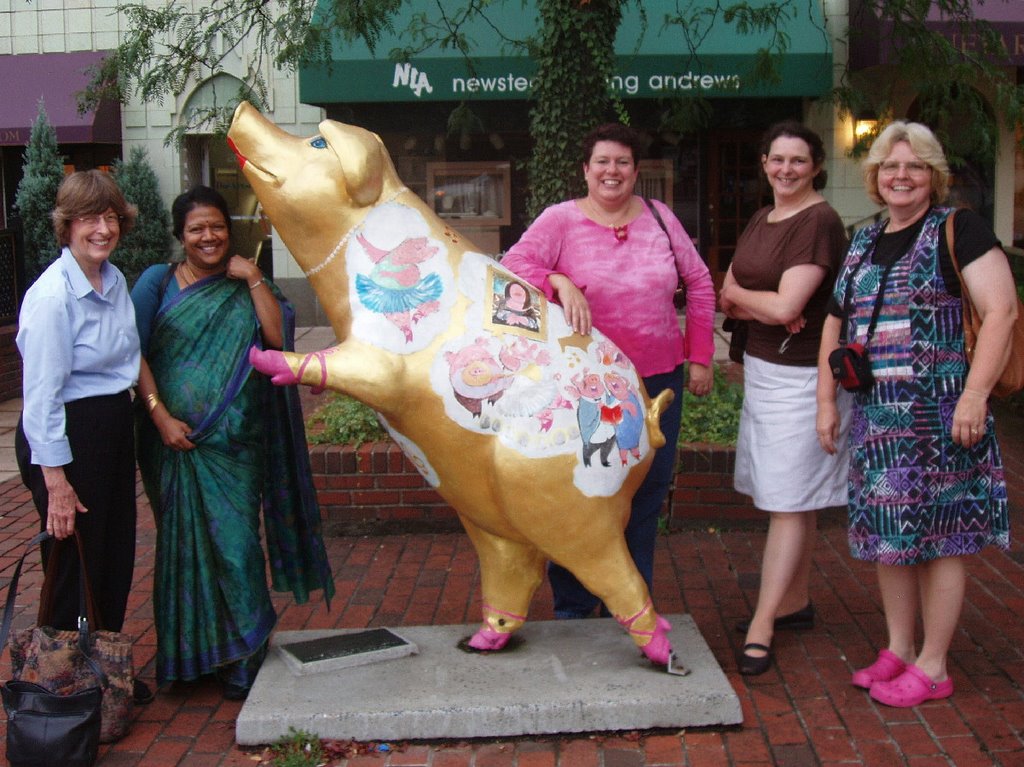
When I saw this painted pig, I insisted that a passerby take our picture with the pig.
Here we are: Jeannette, Olga, Roni, Julia, and Alice. Now, how often do you picture an Olga wearing a traditional sari? She always does!


Afterward, we had Really Great Ice Cream at Graeter's. I rode with Olga back to the Cinta Center. Roni doesn't use her turn signals!

Friday, July 28, 2006

New Tricks

A first this morning. I couldn't figure out how to turn on the shower in my room at the Holiday Inn in Kearny, Nebraska. My C.V.: I've stayed in a lot of hotel rooms, overnighted with family & friends, had quite a few of my own addresses in seven states. Never have I been unable to make a shower work. (Regulating water temperature can be trickier & will not be addressed here.) I've got an engineering degree and made a career working in situations where the unknown had to be examined to correct a problem. (Said problems usually involved human input from someone who insisted in the face of hard evidence to the contrary that they had followed directions EXACTLY!) By most standards, I am qualified to turn on showers worldwide.

A call to the front desk brought several suggestions from Ty, all involving buttons and levers that didn't exsist. He offered to come up to show me, but since I was puffy-eyed with morning breath & bed hair, wearing only my birthday suit, I declined. Bad move, as it only delayed the inevitable. I dressed hastily in a combination of yesterday's rumpled clothing and pajamas, not bothering with toothpaste or comb. Ty politely ignored my personal appearance. The shower baffled him as well, making me feel better.

The solution involved pulling down on a ring on the spigot. New one, which I have added to my repertoire. One shower and a Diet Pepsi later, I am more amused. You can teach an old dog new tricks.

Monday, July 24, 2006

Sleight of Hand

There has been a discussion on QuiltArt recently about the cost of hand-dyed fabric. DebbieHomeDyer did some math and came up with $4.50 out-of-pocket cost for 1 yd of hand-dyed fabric. (30 yd bolt of PFD at ~3.95/yd, 3.95 for 2 oz dye - enough to dye 8 yds, pennies for soda ash.)

I think she did a sort of mathmatical sleight of hand.

First, while the cost of soda ash needed to dye a yard of fabric is just pennies, you still have to buy at least a pound (Dharma has 1 lb for $1.69). Ignoring shipping charges, your out-of-pocket cost is $1.69, not just the $.40 worth actually used to dye those 8 yds. I could also argue that the cost of the 22 yds you haven't dyed must also be included in your out-of-pocket cost. I bet you bought a full bolt to get a lower price per yard. What about synthrapol? $4.09 for 16 oz.

What are you going to dye in? Baggies, tubs, buckets, measuring spoons, jars - they all have a cost. Maybe if you are dyeing a few yards every once in a while for your own use, you can use "stuff that was sitting around the house", but by the time you finish dyeing that 30-yd bolt, you'll have made at least one trip to the dollar store to buy a measuring cup with readable lettering, a set of spoons so you can measure 1/2 TBL instead of eyeballing "something close" with the 1 TBL measuring spoon you have. You'll have bought more dixie cups to replace those you took out of the bathroom. And you have replaced the kitchen towels that don't match the kitchen color scheme anymore, thanks to dye mop-ups.

FYI: Both DebbieHomeDyer and I completely ignored the cost of rinsing, washing, drying, and ironing this fabric.

If you got the color/shade you wanted in the 8 yds you dyed, hooray! Give yourself a pat on the back. More likely, you'll end up dyeing a few more yards trying to get that certain color. Sidebar: I have 10-20 shades of green in stock at any given time. And I STILL have customers who can't find the green they want/need.

Anyway, my point is that you can't dye a few yards of fabric for $5 a yard. Not having done any calculations, just making a guess, I would say that you might have to dye about 100 yards to get into that cost range. So, when your out-of-pocket expense is in the neighborhood of $500, does my $18 and $20/yd fabric seem so expensive?

Speaking of sleight of hand, I noticed something strange this past weekend. Quilters were watching a demonstration of a quilting system that uses your home machine & has a frame to support the quilt. No one asked for the dimensions of the machine cart so they could check to see if their machine would fit. They weren't thinking about how different a real quilt would behave compared to the demonstrator 45" wide fabric sandwich, pre-basted in a 1" diagonal grid. (I've seen a lot of quilts that were more lightly quilted than this basting!) No one wondered aloud about how the thin stick support would handle the bulk of a king-size quilt.

I was amused to see that most people watching the demo were looking at the quilting being done, rather than evaluating the system. I know it is a natural reaction to watch something in motion and that is exactly what happened! For the record, I don't think the designer/salesman was intentionally trying to pull a fast one. He just used an optimum set-up for his demo. And it sold them!

What sleight of hand can I use to get people to buy my fabric?

Tuesday, July 11, 2006

Artist Walk

MULBERRIES
I set out yesterday with Casey and camera, having decided to play with the macro feature on the camera. It was surprising how many things I noticed when I quit looking at The Big Picture and began to study the details. After detouring around the sidewalks splattered with mulberries, I stopped to take a picture of berries still on the tree. (I also ate a couple, but they don't taste as yummy as they did when I was a carefree child in Ohio.) The black walnut trees have a bumper crop. I believe my first dyeing experience was accidently-on-purpose coloring my hands with the hulls!

My next photography attempt was of a new (to me) flower that was in the landscaped areas where trail meets neighborhood. After a dozen attempts, this was the best shot. I was trying for a clear shot of the stamens, thinking ahead to a combination of applique and beading. The stem is a stylized pineapple, flat & symmetrical. If anyone knows what this flower is, please leave a comment!
ORANGE FLOWER

Wild grapevines caught my attention and I was very pleased with this shot of a bunch in various stages of ripening.
WILD GRAPES

I batted about .500 with good/not-good macro shots. Raindrops on pine needles, tiny yellow balls of petals, and a carpet of black walnut hulls under the tree where we took shelter from a light rain were all not good enough to make the cut. Casey's whiskers and interesting leaf shapes were were better.

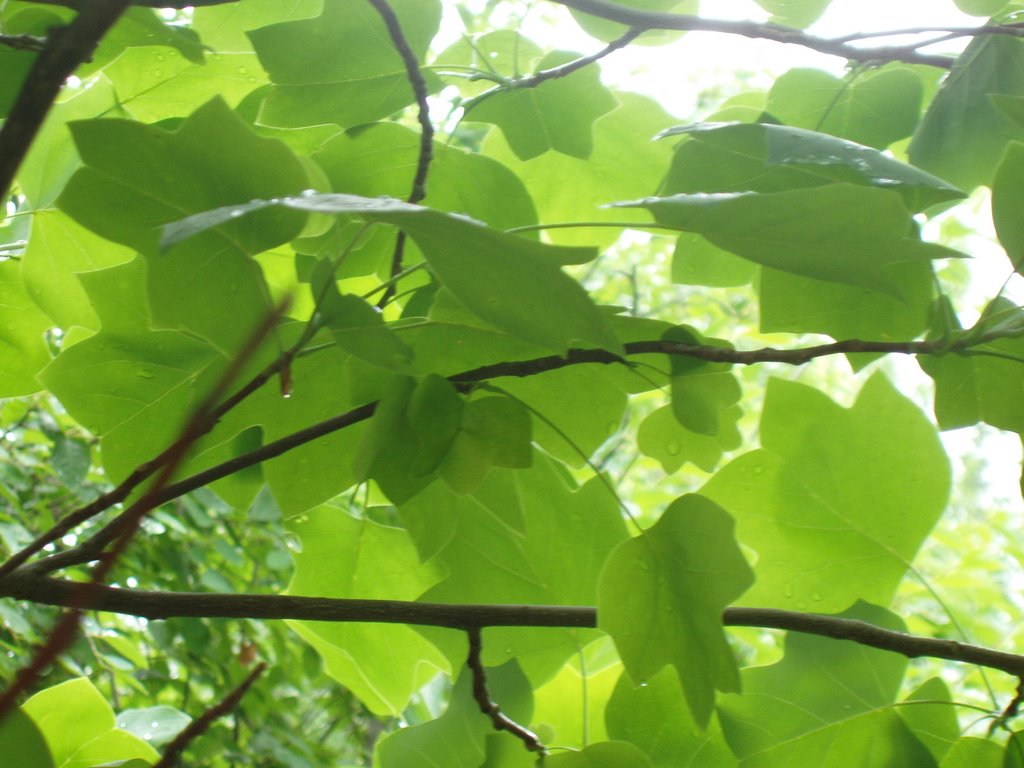
And saving my favorite for last, I loved the way the light came through the leaves when I ducked under this tree. I used a flash for the first shot and it looks VERY flat. The 2nd show, sans flash, is what I saw. Wonderful shades of color interplaying with light! In addition, these leaves look like the star leaves that the dinosaurs were hunting in one of The Land Before Time movies.


On the way home, I found a tiny bird egg (bluebird, I think) beside the trail. I picked up a small piece of blue glass with writing (names of cities, which will go into my collection of found objects for a quilt about places. I picked up and discarded a piece of plastic with a Nissan logo. My favorite tree on the trail, which has HUGE leaves, also has seed pods - 2 feet long & skinny & round. Such a wonderful contrast to the leaves in shape, while maintaining scale. My right knee hurt, so I was walking slowly. Rain was threatening, so I didn't stop to take any pictures.

Sunday, July 09, 2006

Why Use One Fabric When You Have Twenty?

When I make quilts, I like to work with many fabrics, rather than a few. Making these "scrap" quilts always generates SCRAPS! I saved the long skinny ones for string piecing. Most of the chunky scraps I threw away. But my hand-dyed fabric scraps were too precious to discard. When the scrap collection outgrew the first three storage boxes, each larger than the one before, I decided I had to start using them. I call the technique I've been exploring for about a year "Too Small To Keep - Too Big To Throw Away" (TSTK-TBTTA). These scraps fall into the 2-4" range. Bigger scraps are big enough to do something with, smaller scraps are a PITA to work with.

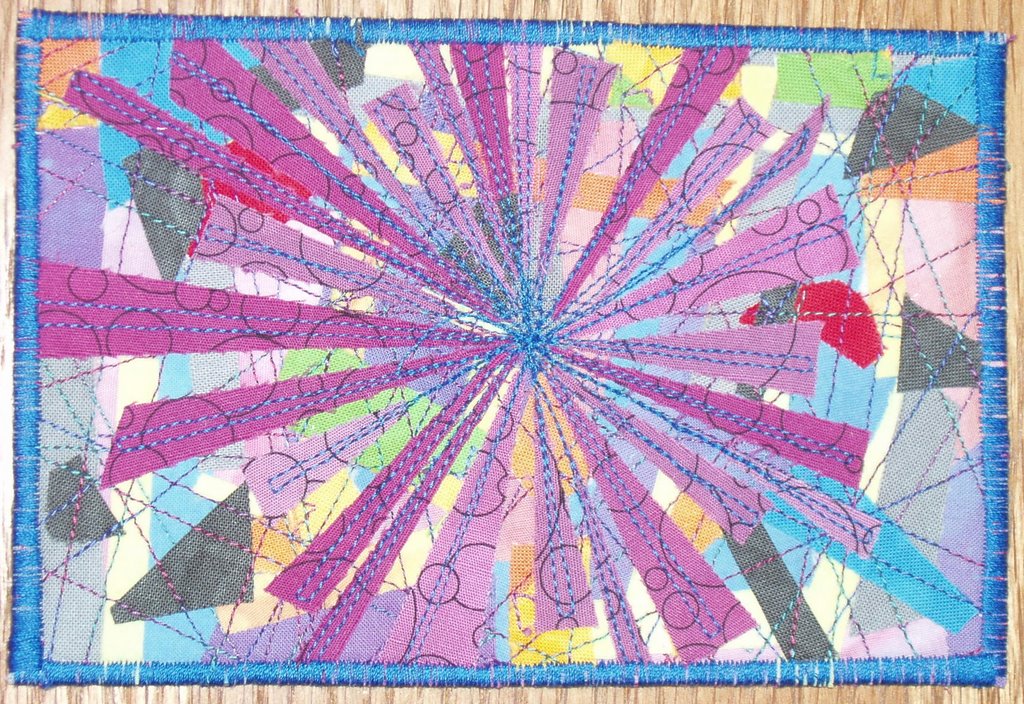
And yet, I found myself fusing these teeny scraps to a 4" x 6" Peltex postcard base. Scraps with fusible web on them, trimmed off a TSTK-TBTTA scrap. Scraps that are smaller than PITA-size scraps. Scraps so small that I normally don't even hesitate before tossing them into the trash. Scraps so small that they don't deserve to be called scraps! And I was using them.

My placement technique was simple - the scrap should cover Peltex, not other scraps. When I had the entire base covered with a jarring collection of color and shape, I "quilted" by sewing many straight lines at odd angles across the scraps.

Leftover from June's Journal Quilt were quite a few sort-of/almost triangular pieces of pink fabrics. These became the petals of my FireWorks Flower. I like how the flower quiets the explosion of color of the background. I'm not crazy about the dark gray chunks near the edges of the postcard, but I decided to think of them as the paper housing which gets blown away unnoticed when fireworks are set off.

This postcard will be mailed to the next person (Betty H) on my Omaha Postcard Exchange List.


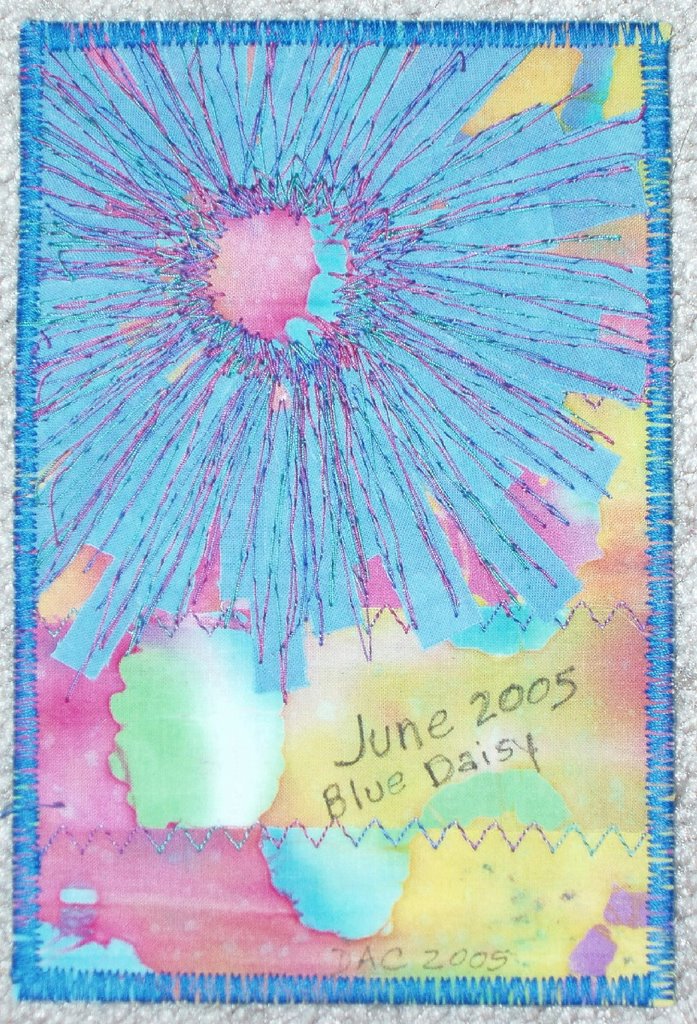
The 2nd postcard is Blue Daisy. I finished the postcard, signed it, wrote the date as 2005 not once, but THREE times. Twice on the front, once on the back. If not for a daughter who pointed it out, I might never have caught my error. After four days of agonizing over my error, I mailed it to my June Postcard recipient without correction. My first ever late mailing :(